
Heavy Pakistani shelling in the border district of Poonch in Jammu and Kashmir left nine people dead and 28 injured. The shelling, described by residents and officials as "barbaric and cowardly", started around 2 am, damaging dozens of residential houses, shops, vehicles, and heritage sites. The incident comes after India launched "Operation Sindoor" in retaliation to the April 22 Pahalgam terror attack. India condemned the act, calling it a cowardly attack on civilians, and reaffirmed that civilian safety remains its top priority.

India imports goods worth over Rs 1,200 crore from Turkey annually, including a significant share of fruits like apples.
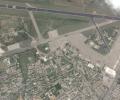
India's strikes on Pakistan damaged runways and structures across at least six airfields, according to a visual analysis by The Washington Post, which experts said were the most significant attacks of their kind in decades of simmering conflict between the two nations.
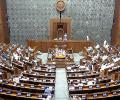
Congress general secretary in-charge communications Jairam Ramesh said that at a time when the BJP should be targeting Pakistan and terrorists, it is only interested in attacking the Congress.

'The Asia Cup matter or any other ACC event issue has not come up for discussion at any level, hence any news or report on that is purely speculative and imaginary.'
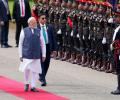
India's concerns over a planned naval exercise between Pakistan and Sri Lanka in the strategically important waters of Trincomalee led to the shelving of the drills weeks ago. The exercise was planned as part of regular engagements between the two navies, but India expressed its apprehensions to the Sri Lankan government. Trincomalee, situated on Sri Lanka's northeastern coast, is considered a significant hub in the Indian Ocean region, particularly for India's maritime security interests. The Pakistani Navy's close cooperation with China's PLA Navy has raised concerns in New Delhi about any Pakistani warship presence in Trincomalee. This incident follows previous diplomatic rows between India and Sri Lanka over the docking of Chinese vessels at Sri Lankan ports. India has been actively supporting Sri Lanka's development of Trincomalee's energy infrastructure and has recently signed a defense pact with the country to boost military cooperation.
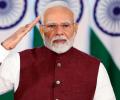
Operation Sindoor has carved out a new benchmark in our fight against terrorism, and has set up a new parameter and new normal. Operation Sindoor is not just a name but a reflection of the emotions of millions of Indians. Operation Sindoor is an unwavering pledge for justice. Terrorists dared to wipe 'sindoor' from the foreheads of our sisters; that is why India destroyed the very headquarters of terror.
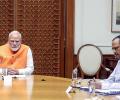
India's National Security Advisor Ajit Doval briefed US Secretary of State Marco Rubio on the country's missile strikes against nine terrorist targets in Pakistan. The strikes, dubbed "Operation Sindoor," targeted terrorist infrastructure in Pakistan and Pakistan-occupied Jammu and Kashmir. India stated that the strikes were measured, responsible, and non-escalatory in nature, targeting only known terror camps. The strikes followed a deadly attack on civilians in Jammu and Kashmir on April 22, for which India has accused Pakistan-based terrorists. The Indian government has cited credible leads, technical inputs, and survivor testimony as evidence of Pakistan's involvement in the attack.
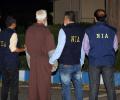
He was sent to judicial custody on May 9 and lodged in Tihar jail after his custodial interrogation by the NIA.
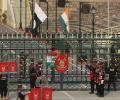
In the India-Pakistan situations, off-ramps have come either through foreign mediation (after months of kinetic warfare over Kargil, and a long stand-off with Op Parakram) or when a situation made it possible for both sides to claim a win, explains Shekhar Gupta.

According to the 2021 England and Wales Census data, of the 915,855 citizens born in India, 49 per cent (444,500) said English was their main language, followed by 41 per cent (373,583) who said another language was their main language but that they spoke English very well or well.
'Had Haji Pir and/or Skardu been taken, the message would have gone out not just to General Asim Munir and his cohort in the Pakistan army but to the Pakistani people that every terrorist incident in India would lead to substantial loss of territory in PoK.'
Police on Tuesday said they have started recording statements of people associated with the controversial Veera Sathidar memorial programme held on May 13 in Nagpur, where the poem was recited, while an official informed investigation into the case was at a sensitive stage.
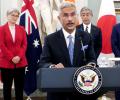
If the only superpower, which calls India an ally, sees the region through an India-Pakistan prism, it is unacceptable. Rather than endorse India's sphere of influence, this undermines it, asserts Shekhar Gupta.
A team from India's National Investigation Agency (NIA) has reached Pahalgam in Jammu and Kashmir to assist local police in investigating a deadly terrorist attack that killed 26 people, mostly tourists, on Tuesday. The NIA team visited the site of the attack, Baisaran meadow, known for its scenic beauty. Security agencies have released sketches of three suspected Pakistani terrorists involved in the attack, identified as Asif Fauji, Suleman Shah, and Abu Talha. The Resistance Front (TRF), a shadow outfit of the Lashkar-e-Taiba terrorist group, claimed responsibility for the attack.
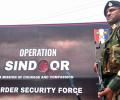
Their shared brief: To assert India's case with clarity, rebut hostile narratives, and secure enduring partnerships for global counter-terror cooperation.

'Imran Khan's rule was dismal. Despite this, he has become a cult figure.' 'He sold the dream of a Naya Pakistan to the people of Pakistan, especially the youth, and branded all other politicians as corrupt.' 'Hence, his popularity.'
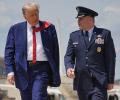
He then went on to say that, however, he won't get a Nobel Peace Prize for any of his efforts.

Congress leader Rahul Gandhi on Friday accused External Affairs Minister S Jaishankar of "collapsing" India's foreign policy and questioned the government's handling of the recent tensions with Pakistan, particularly the US President Donald Trump's role as a mediator. Gandhi's remarks come amidst a war of words between the Congress and the ruling BJP over their leaders' statements on the Indo-Pak conflict.
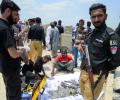
'This strike has certainly enhanced your image.' 'Otherwise, people would have called you a damp squib, capable of doing nothing except talking big.'
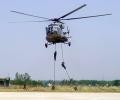
'Pakistan cannot sustain a war with India for more than four days. They are in such dire straits. At best they can sustain war for one week.'

The father of a BSF jawan detained by Pakistan Rangers after inadvertently crossing the international border in Punjab has said that the family is anxiously waiting for his return. The jawan, P K Sahu, was taken into custody on Wednesday after he reportedly walked ahead to rest under a tree and inadvertently crossed over into Pakistan territory. The commanding officer of the jawan's battalion has said a flag meeting is being held to secure his release.
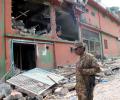
'Indian Army officers always lead their men into battle or combat. Pakistani officers are seldom seen at the front.'
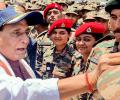
'You can be sure that the Pakistanis knew when the Indian Air Force aircraft took off, which type these were, and what their likely targets were.' 'The question was: How would they determine that the IAF wanted to fire, and when to bounce them?', notes Shekhar Gupta.

An operation was underway to find if more people were involved in espionage against India and several YouTube channels were under scrutiny, a top Haryana official said on Tuesday after five, including a Youtuber, were nabbed from the state for spying.
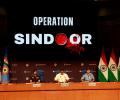
The logo for India's Operation Sindoor, which has captured the imagination of millions, was designed by two Armymen. The operation, a decisive military action against terror camps in Pakistan and Pakistan-Occupied-Kashmir, was launched in response to the Pahalgam massacre. The logo, featuring a bowl of vermilion, has become a powerful symbol of India's resolve against terrorism.
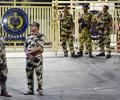
Security has been heightened outside the National Investigation Agency (NIA) headquarters in New Delhi, where Tahawwur Rana, the mastermind of the 2008 Mumbai terror attacks, is being held following his extradition from the United States. Rana was brought to India after the US Supreme Court dismissed his review plea against extradition. The NIA secured an 18-day custody of Rana after he was produced before a special court in Delhi. Additional police and paramilitary forces have been deployed to ensure law and order. The extradition of Rana, a close associate of David Coleman Headley, the main conspirator of the Mumbai attacks, is a significant development in the investigation into the 2008 attacks.

The hugely significant development comes just days after Rana's last-resort attempt to evade extradition to India failed after the US Supreme Court justices denied his application, moving him closer to being handed over to Indian authorities to face justice in the dastardly attacks.

The United States has extradited Pakistani-Canadian Tahawwur Hussain Rana to India to face charges for his alleged involvement in the 2008 Mumbai terrorist attacks. Rana, 64, was convicted in the US in 2011 for providing material support to Lashkar-e-Taiba, the Pakistani militant group responsible for the Mumbai attacks. The US Department of State said it has long supported India's efforts to bring those responsible for the attacks to justice and that the extradition is a critical step towards seeking justice for the victims. Rana's extradition comes after the US Supreme Court denied his last-ditch attempt to evade extradition. He will now face justice in India for his role in the attacks which killed 166 people, including six Americans.

India has accused Pakistan of being a "rogue state" fueling global terrorism, following a confession by Pakistan's Defence Minister Khawaja Asif admitting to his country's history of supporting and funding terrorist organisations. India's Deputy Permanent Representative to the UN, Ambassador Yojna Patel, delivered a strong Right of Reply at a UN event, highlighting Asif's admission and condemning Pakistan's actions. Patel asserted that the world can no longer turn a blind eye to Pakistan's role in supporting terrorism.
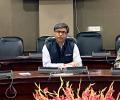
The sources said Misri reiterated the government's stand that the decision to stop military actions was taken at a bilateral level, as some opposition members questioned US President Donald Trump's repeated assertions about his administration's role in stopping the conflict.
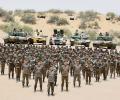
He also reviewed the joint actions undertaken in coordination with the Indian Air Force and the Border Security Force, they said.

India is proposing a new law that would impose a jail term of up to seven years and a fine of Rs 10 lakh on anyone found using a forged passport or visa to enter, stay, or exit the country. The Immigration and Foreigners Bill, 2025, also mandates reporting of foreign visitors by hotels, universities, and hospitals to track overstaying individuals. The bill aims to simplify laws, ease business, and strengthen national security while promoting economic growth and tourism.
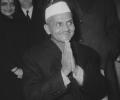
The high point of the 19 Shastri months was the 22-day war that he fought against great odds and won in principle, even if military historians often call it a stalemate. Pakistan saw a great opportunity to conquer Kashmir and lost. It was the last time they had the relative strength militarily and diplomatically to take Kashmir. Shastri's resolve buried that dream forever, points out Shekhar Gupta.

Shakur Khan was detained on Wednesday night by an intelligence department team who were acting on security-related inputs.
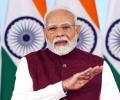
Presenting the full text of Prime Minister Narendra Modi's address to the nation on May 12, 2025, in which he dictated India's new doctrines on countering terrorism.

India will oppose the World Bank funding to Pakistan next month, arguing that Islamabad has used such funds in the past to procure arms and ammunitions. India previously lobbied against the IMF extending a USD 2.3 billion assistance to Pakistan earlier this month, presenting evidence of Pakistan's misuse of funds for military purposes. India feels that Pakistan has failed to act on terror emanating from its territory and has been diverting funds from multilateral agencies to buy arms and ammunition.

Following the precision strikes, India reached out to several world capitals and briefed senior officials about its anti-terror actions against Pakistan.
A court in New Delhi has sent Tahawwur Hussain Rana, the mastermind behind the 2008 Mumbai terror attacks, to 18 days of National Investigation Agency (NIA) custody. The court cited the need for sustained interrogation to uncover the extent of the conspiracy and the involvement of multiple targets across India, including New Delhi. Rana, a Pakistani-origin Canadian businessman and close associate of 26/11 conspirator David Coleman Headley, was extradited to India after the US Supreme Court dismissed his review plea against his extradition.
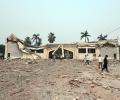
A 4.6 magnitude earthquake shook parts of Pakistan on Monday with the epicentre located close to a prominent faultline in its Punjab province, the director of the National Center for Seismology (NCS) said.
